
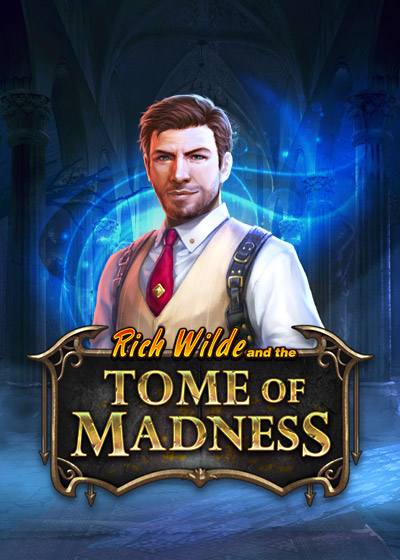
Rich Wilde and the Tome of Madness
Rich Wilde and the Tome of Madness: Full Mechanics Breakdown
Rich Wilde and the Tome of Madness uses a cluster-pays grid wrapped in Lovecraftian horror imagery. Play’n GO sets the game at 96.59% RTP, with high volatility and a 2,000x maximum win. We publish those figures upfront — so players can review the maths before staking real funds. The game is available on our platform in free demo mode without registration, alongside real-money play after login. Every specification below comes from the verified game engine — not promotional material.
Core Mechanics and Grid Structure
A 5×5 grid replaces traditional reels. Wins form through cluster-pays logic: four or more matching symbols must touch horizontally or vertically, with diagonal contact ignored. Play'n GO labels this configuration as "4 ways," though the term refers to minimum cluster size rather than fixed paylines. Cluster formation can span multiple rows simultaneously, fundamentally altering how you read winning patterns compared to 20-line or 243-way slots. Rich Wilde and the Tome of Madness strips away linear payline mechanics entirely.
Cluster Pays and Cascading Wins
Matched symbols disappear after paying. New symbols drop from above to fill vacant cells—a cascade that repeats until no fresh cluster emerges. Each cascade within a single spin carries potential for additional wins, compounding volatility across sequential drops rather than isolating payout events. The design rewards sustained engagement over rapid spin-cycling, since variance accumulates through cascade chains instead of resetting between base spins.
Three structural rules govern cascade behaviour:
- Symbols removed from a cluster remain absent until the next full spin initiates.
- Refill symbols descend from fixed column positions, maintaining consistent drop patterns.
- Cascades terminate only when no four-symbol cluster forms after a refill completes.
Wild Symbols and Multiplier Mechanics
Wilds substitute for all paying symbols and appear in both base play and triggered features. The Mega Wild covers a 2×2 block, occupying four grid positions and significantly raising cluster formation probability across adjacent cells. Multiplier Wilds attach a fixed value to any cluster they complete; that multiplier applies before the cascade sequence advances.
This differs sharply from Immortal Romance II, where multipliers accumulate across free spin rounds rather than within a single cascade chain. Within Rich Wilde and the Tome of Madness, multiplier values reset once the cascade terminates.
Portal, Abyss and Void Features
Three interconnected mechanics distinguish this title from standard cluster slots. Portal activation during base play converts standard symbols to wilds before cascade evaluation. Abyss and Void operate as escalation states, triggered under specific grid conditions and modifying symbol behaviour for the duration of an active spin sequence.
Read these three features in combination to understand why Rich Wilde and the Tome of Madness carries high volatility despite a moderate 2,000x cap: the payout curve depends on stacking triggers within a single cascade run, contrasting with the fixed jackpot approach in Blue Wizard slot.
Eye Marks and the Other World Free Round
Eye Marks accumulate across spins without expiring between rounds. Once the required count is reached, the Other World Free Round activates—a separate game state with altered symbol distribution and modified cascade rules. This mechanic contributes independently to the overall 96.59% RTP figure, with its hit frequency calculated separately from base-grid returns. The structure mirrors collectible-trigger systems in Adventures Beyond Wonderland, though Eye Marks reset only after the Other World Free Round concludes in Rich Wilde and the Tome of Madness.
Confirmed RTP, Volatility and Payout Specifications
We publish Play'n GO's certified data for Rich Wilde and the Tome of Madness without rounding or approximation.
|
Specification |
Confirmed Value |
|
Provider |
Play'n GO |
|
RTP |
96.59% |
|
Volatility |
High |
|
Grid Format |
5 reels × 5 rows |
|
Paylines/Ways |
4 (cluster pays) |
|
Minimum Bet |
0.10 CAD |
|
Maximum Bet |
100.00 CAD |
|
Maximum Win |
2,000× stake |
At 96.59%, Rich Wilde and the Tome of Madness sits marginally above Play'n GO's catalogue median. High volatility signals wider variance between dry sequences and cascade-driven peaks—a distribution pattern structurally distinct from the flatter payout profile in Immortal Romance, which operates under low-to-medium volatility.
Betting Range and Stake Controls
Stake configuration spans 0.10 to 100.00 CAD per spin. Bet size directly scales cluster value, since every payout multiplier applies against the active stake rather than a fixed coin denomination. Three figures matter most before you adjust wager settings:
- Minimum bet of 0.10 CAD supports extended low-stakes sessions.
- Maximum bet reaches 100.00 CAD for higher-exposure play.
- Maximum win caps at 2,000× the triggering stake, irrespective of cascade length.
Stake selection interacts directly with volatility—smaller bets extend session duration against the same variance curve, a pattern evident across our Play'n GO games collection.
Mobile Access and Technical Framework
HTML5 underlies Rich Wilde and the Tome of Madness, the same framework Play'n GO has deployed across its catalogue since 2005. Cluster grid, cascade animations, and Eye Mark tracking render identically on smartphone browsers and desktop clients, with no separate app required. Load times remain consistent across devices, and the 5×5 grid scales proportionally to smaller screens without cropping active cluster zones.
Responsible Gambling
High volatility can produce long gaps between cascading wins — that’s part of the game’s maths, not an unusual event. Treat every stake as entertainment spending. Set a session budget before playing and use deposit or loss limits where available. The 2,000x maximum win is a theoretical ceiling based on millions of simulated spins — not an expected result for a single session. Play only with money you can afford to lose, and stop once the activity no longer feels entertaining.